


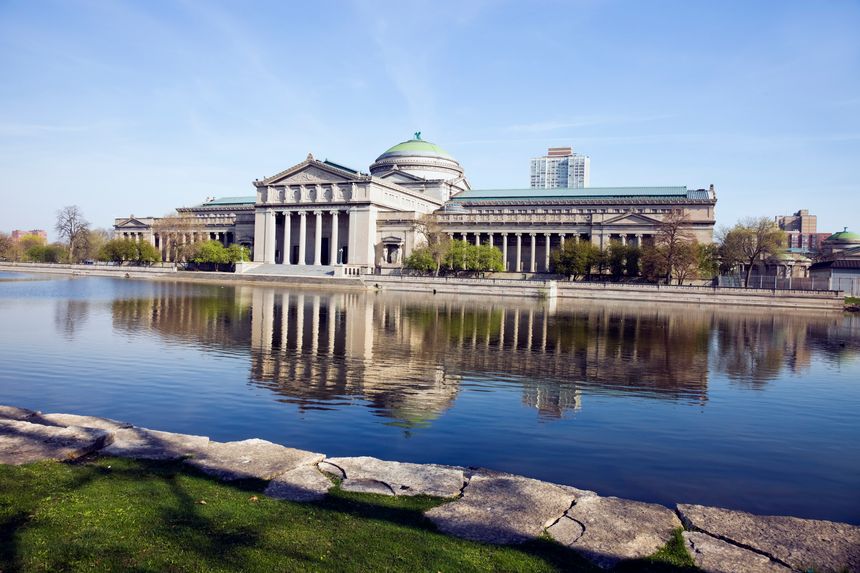
Workers at the Museum of Science and Industry in Chicago just ratified their first union contract. Elsewhere in the city, employees at the Adler Planetarium voted last Thursday in favor of forming a union. But the trend of employees at cultural institutions unionizing is not limited to Chicago. Across the country, employees at museums, zoos, libraries, aquariums, and other cultural venues are turning to unions during uncertain economic times.
According to the American Federation of State, County & Municipal Employees (AFSCME), which claims to represent more museum workers than any other union in both the public and private sector, they represent employees at the MET, the Brooklyn Museum, the Museum of Contemporary Art L.A. (MOCA), Academy Museum of Motion Pictures, the American Museum of Natural History, the Art Institute of Chicago, the Baltimore Museum of Art, the Philadelphia Museum of Art, and many others across the country. AFSCME also represents members at botanical gardens, zoos, aquariums, historical societies, planetariums, science centers, and other cultural institutions.
Several key economic factors are driving this current union organizing trend, including inflation and job security. In this environment, employees are motivated to seek the protections that higher pay and increased benefits offer. However, about one-third of nonprofit museums and cultural institutions are also struggling to confront the loss of government grants or contracts. More than half of museums reported fewer 2025 visitors than in 2019, according to a November report by the American Alliance of Museums. In spite of these conflicting economic difficulties, employees are continuing to push back, feeling that they have been taken for granted for many years.
Bottom line: unions continue to seek out new groups of workers to organize as their traditional targets, such as manufacturing and production jobs, wane or move overseas. Nonprofit employers would be well advised to stay engaged with their employees, keep an eye on employee morale, and look for ways to reward employees' hard work even when funds are scarce.
/Passle/68b577fd8118878331f0b95e/SearchServiceImages/2026-03-06-14-39-49-609-69aae735e5114c7e5295935c.jpg)
/Passle/68b577fd8118878331f0b95e/MediaLibrary/Images/2026-02-05-19-03-42-414-6984e98ed522dbbaed5f8c68.jpg)
/Passle/68b577fd8118878331f0b95e/SearchServiceImages/2025-12-29-14-30-37-025-6952908dad04586c3adaa04c.png)
/Passle/68b577fd8118878331f0b95e/SearchServiceImages/2025-12-09-03-25-30-124-693796aa6a72147741bd19d7.jpg)